By mumu
If your container plants look healthy but aren’t growing as well as you’d expect — or if they’re producing fewer flowers and fruits than they should — the problem is almost always fertilizer. Either too little, the wrong type, or applied at the wrong time.
Fertilizing container plants is one of the most important — and most misunderstood — parts of container gardening. Unlike plants growing in the ground, container plants can’t reach out to find nutrients in surrounding soil. They depend entirely on what’s in their pot — and those nutrients wash out every time you water.
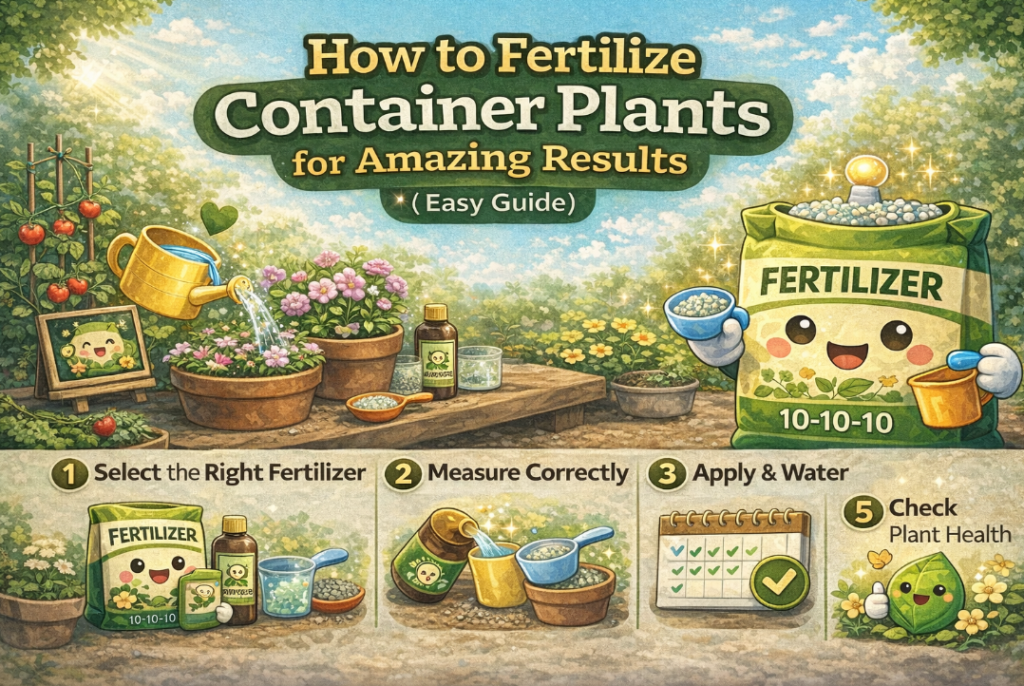
Here is everything you need to know about how to fertilize container plants correctly, including when to feed, what to use, and how often to apply it.
Table of Contents
- Why Container Plants Need Regular Fertilizing
- Types of Fertilizer for Container Plants
- Understanding NPK Ratios
- When to Start Fertilizing Container Plants
- How Often to Fertilize Container Plants
- Fertilizing Vegetables in Containers
- Fertilizing Flowers in Containers
- Fertilizing Herbs in Containers
- Common Fertilizing Mistakes to Avoid
- Signs Your Container Plants Need Fertilizer
1. Why Container Plants Need Regular Fertilizing
Every time you water a container plant, some nutrients wash out through the drainage holes. This is unavoidable — it’s the nature of container growing. Over time, the potting mix becomes depleted of the essential nutrients that plants need to grow, flower, and produce fruit.
In the ground, nutrients are constantly replenished by organic matter decomposing in the soil, earthworm activity, and rainfall. In a container, none of these natural processes occur. The only way nutrients get replenished is through fertilizing.
This is why fertilizing container plants is not optional — it’s essential. Even the most expensive, nutrient-rich potting mix will be depleted within 4–6 weeks of regular watering.
2. Types of Fertilizer for Container Plants
| Fertilizer Type | How It Works | Best For | Frequency |
|---|---|---|---|
| Liquid fertilizer | Mixed with water and applied during watering | Vegetables, flowers, fast-growing plants | Every 1–2 weeks |
| Slow-release granules | Mixed into soil or sprinkled on surface — releases nutrients over months | All container plants, low-maintenance gardens | Every 2–3 months |
| Water-soluble powder | Dissolved in water before applying | Vegetables, flowering plants | Every 1–2 weeks |
| Organic fertilizer | Made from natural materials — releases nutrients slowly | Edible plants, eco-conscious gardeners | Every 2–4 weeks |
| Fertilizer spikes | Inserted into soil — dissolves slowly with watering | Indoor plants, houseplants | Every 1–2 months |
For most beginner container gardeners, liquid fertilizer is the best choice. It works quickly, is easy to control, and can be adjusted based on what your plants need at each stage of growth.
3. Understanding NPK Ratios
Every fertilizer label displays three numbers — for example, 10-10-10 or 5-10-5. These numbers represent the percentage of the three main nutrients in the fertilizer:
| Letter | Nutrient | What It Does | Best For |
|---|---|---|---|
| N | Nitrogen | Promotes leafy, green growth | Herbs, lettuce, leafy greens |
| P | Phosphorus | Promotes root development and flowering | Flowering plants, seedlings |
| K | Potassium | Promotes fruit development and overall plant health | Tomatoes, peppers, fruiting plants |
Quick guide:
- For leafy plants (herbs, lettuce, spinach) → choose a fertilizer higher in N (nitrogen)
- For flowering plants → choose a balanced fertilizer or one higher in P
- For fruiting plants (tomatoes, peppers) → switch to a higher K fertilizer once flowering begins
4. When to Start Fertilizing Container Plants
The timing of when you start fertilizing depends on what’s already in your potting mix:
- If your potting mix contains slow-release fertilizer — Wait 4–6 weeks before adding additional fertilizer. The slow-release pellets will feed your plants during this time.
- If your potting mix does not contain fertilizer — Start fertilizing 2 weeks after planting, once the plant has had time to establish its roots.
- For seedlings — Wait until the seedling has developed its first set of true leaves before fertilizing, and use a diluted (half-strength) fertilizer to avoid burning tender roots.
In general, the active growing season — spring through early fall — is when container plants need the most fertilizer. Reduce or stop fertilizing in late fall and winter when most plants slow down or go dormant.
5. How Often to Fertilize Container Plants
| Plant Type | Fertilizer Type | Frequency |
|---|---|---|
| Vegetables | Liquid balanced fertilizer | Every 1–2 weeks |
| Flowering plants | Liquid high-potassium fertilizer | Every 1–2 weeks |
| Herbs | Liquid balanced fertilizer (diluted) | Every 3–4 weeks |
| Succulents and cacti | Diluted liquid fertilizer | Once a month in summer, not at all in winter |
| Indoor plants | Liquid or slow-release fertilizer | Every 2–4 weeks in growing season |
6. Fertilizing Vegetables in Containers
Vegetables are the heaviest feeders of all container plants. They need consistent nutrition throughout the growing season to produce well.
Vegetable fertilizing schedule:
- Seedling stage — Half-strength balanced fertilizer every 2 weeks
- Vegetative growth stage — Full-strength balanced fertilizer (10-10-10) every 1–2 weeks
- Flowering and fruiting stage — Switch to high-potassium fertilizer (tomato feed) every 1–2 weeks
Special note for tomatoes: Tomatoes are especially demanding. Once flowers appear, switch to a tomato-specific fertilizer high in potassium. This promotes fruit set and improves the flavor of your harvest. Never use a high-nitrogen fertilizer on flowering tomatoes — it promotes leafy growth at the expense of fruit.
7. Fertilizing Flowers in Containers
Flowering container plants need regular fertilizing to keep producing blooms all season long. Without consistent feeding, flowering slows down and the plant puts its energy into producing seeds instead.
Use a liquid fertilizer high in potassium (the third number in the NPK ratio) every one to two weeks throughout the blooming season. Look for fertilizers labeled for flowering plants or with an NPK like 5-10-10 or 4-12-8.
Tip: Never skip fertilizing flowering containers during peak summer. This is when they need the most nutrition and when consistent feeding makes the biggest difference in bloom production.
8. Fertilizing Herbs in Containers
Herbs need less fertilizer than vegetables or flowering plants — and over-fertilizing herbs can actually reduce their flavor. Too much nitrogen produces lots of leafy growth but dilutes the essential oils that give herbs their taste and aroma.
Fertilize herbs with a diluted (half-strength) balanced liquid fertilizer every 3–4 weeks during the growing season. Stop fertilizing completely in fall and winter.
Exception: Basil is a faster grower and benefits from fertilizing every 2–3 weeks during the peak growing season.
9. Common Fertilizing Mistakes to Avoid
| Mistake | Why It’s a Problem | What to Do Instead |
|---|---|---|
| Over-fertilizing | Burns roots, causes salt buildup, damages plants | Follow label directions — more is not better |
| Fertilizing dry soil | Concentrated fertilizer burns roots | Always water before fertilizing |
| Using the wrong fertilizer | High nitrogen on fruiting plants reduces yield | Match fertilizer to plant type and growth stage |
| Fertilizing in winter | Plants don’t absorb nutrients when dormant | Stop or reduce fertilizing in fall and winter |
| Never fertilizing | Nutrient deficiency, slow growth, poor flowering | Set a regular fertilizing schedule |
10. Signs Your Container Plants Need Fertilizer
- Pale or yellowing leaves — Often a sign of nitrogen deficiency
- Slow or stunted growth — Plant not getting enough nutrients to grow
- Few or no flowers — Lack of phosphorus or potassium
- Small fruit or poor harvest — Insufficient potassium during fruiting
- Purple-tinged leaves — Often indicates phosphorus deficiency
- Dark green leaves with no growth — May indicate too much nitrogen
Final Thoughts
Fertilizing container plants is one of the simplest ways to dramatically improve how your garden grows. Once you understand what your plants need and when they need it, fertilizing becomes a quick, easy part of your regular container gardening routine.
Pick a good liquid fertilizer, set a regular schedule, and watch your container plants transform. The difference between an unfertilized container and a well-fed one is remarkable. 🌱
Have questions about fertilizing container plants? Visit the Contact page — I’d love to hear from you!
— mumu, Green Garden Tips