By mumu
Container gardening is one of the most accessible, rewarding, and enjoyable hobbies you can take up — regardless of how much space you have, where you live, or how much gardening experience you bring to it. A balcony, a patio, a windowsill, or even a single sunny corner of a room is all you need to get started.
If you’re completely new to container gardening and don’t know where to begin, this guide is for you. Here is everything you need to know to start your first container garden — step by step, from the very beginning.
Table of Contents
- What Is Container Gardening?
- Why Container Gardening Is Perfect for Beginners
- Choosing Your First Containers
- Choosing the Right Potting Mix
- Best Plants for Complete Beginners
- Understanding Sunlight
- How to Water Container Plants
- How to Fertilize Container Plants
- Common Beginner Problems and Solutions
- Your First Container Garden Checklist
1. What Is Container Gardening?
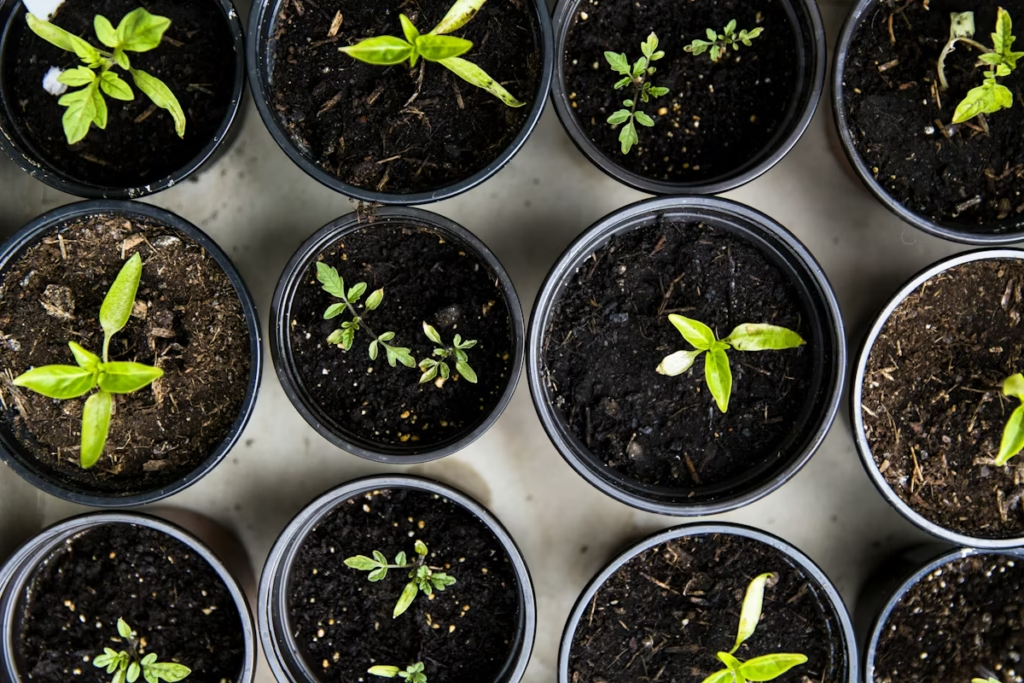
Container gardening is simply the practice of growing plants in pots, containers, or any vessel that holds soil — rather than directly in the ground. The container can be anything from a traditional terracotta pot to a fabric grow bag, a window box, a hanging basket, or even a repurposed bucket or crate.
Container gardening allows you to grow almost anything — flowers, herbs, vegetables, fruits, and ornamental plants — in spaces where traditional gardening is impossible. Apartment balconies, rooftop terraces, small patios, and indoor spaces all become potential gardens with containers.
2. Why Container Gardening Is Perfect for Beginners
| Advantage | Detail |
|---|---|
| No garden required | All you need is a sunny spot — balcony, patio, windowsill, or rooftop |
| Total control | You control the soil, drainage, and growing conditions for each plant |
| Easy to manage | Small scale means less work — perfect for beginners learning the basics |
| Moveable | Move containers to follow the sun, shelter from weather, or bring indoors in winter |
| Low cost to start | A few basic containers and a bag of potting mix is all you need to begin |
| Fast results | Many container plants produce results within weeks — very satisfying for beginners |
3. Choosing Your First Containers
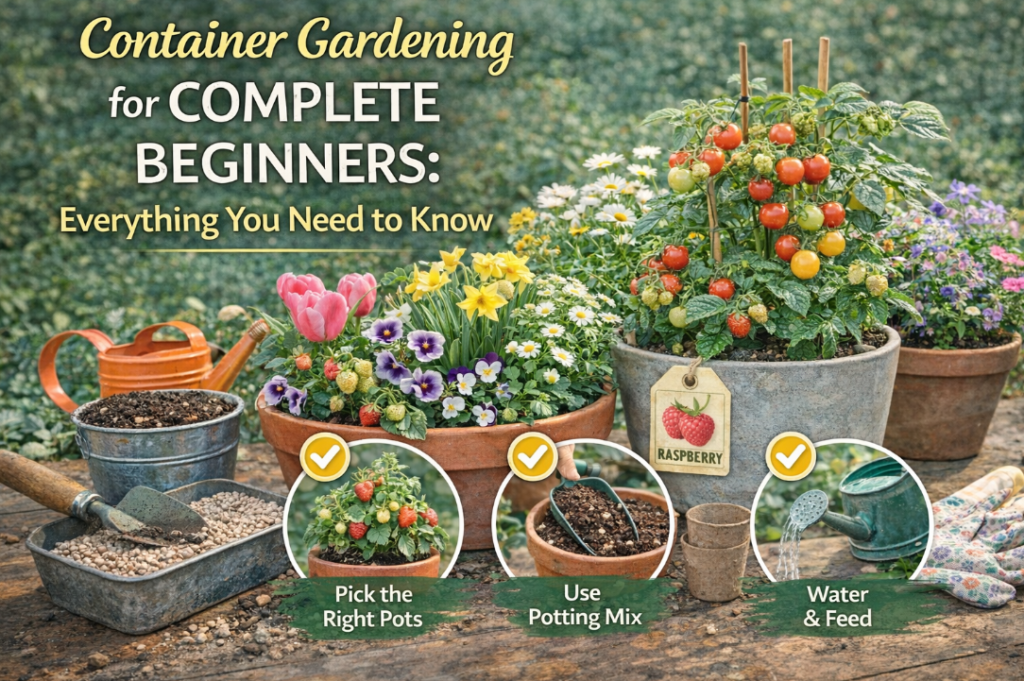
The most important rule when choosing containers: always use pots with drainage holes. Without drainage, water collects at the bottom and roots rot — the most common cause of container plant death.
| Container Type | Best For | Pros | Cons |
|---|---|---|---|
| Plastic pots | Most plants | Lightweight, affordable, retains moisture | Less attractive than other options |
| Terracotta pots | Herbs, succulents, Mediterranean plants | Beautiful, breathable, prevents overwatering | Heavy, breaks easily, dries out fast |
| Fabric grow bags | Vegetables, tomatoes, potatoes | Lightweight, excellent drainage, foldable | Dries out faster than plastic |
| Window boxes | Herbs, flowers, lettuce | Space-efficient, great for balconies | Limited depth for deep-rooted plants |
| Hanging baskets | Trailing flowers, strawberries, herbs | Uses overhead space, beautiful display | Dries out very quickly |
What size container do you need?
- Small herbs and flowers → 6–8 inch pot
- Lettuce and salad greens → 8–10 inch pot, 6 inches deep
- Tomatoes and peppers → 5–10 gallon container
- Large vegetables → 10–20 gallon container
4. Choosing the Right Potting Mix
Never use garden soil in containers — it compacts, drains poorly, and often contains pests and diseases. Always use a potting mix specifically designed for container growing.
What to look for in a good potting mix:
- Lightweight and fluffy — not heavy or dense
- Contains perlite or vermiculite for drainage
- Includes some compost for nutrients
- Drains freely when watered
Simple DIY potting mix: Mix 3 parts potting mix + 1 part perlite + 1 part compost. This works well for most container plants and costs less than premium pre-mixed products.
5. Best Plants for Complete Beginners
| Plant | Why It’s Great for Beginners | Container Size | Difficulty |
|---|---|---|---|
| Basil | Fast-growing, useful in cooking, very rewarding | 6–8 inches | Easy ⭐ |
| Lettuce | Harvest in 30 days, cut-and-come-again | 6 inches deep | Very easy ⭐ |
| Cherry tomatoes | Prolific producer, sweet flavor, very satisfying | 5–10 gallons | Easy ⭐ |
| Marigolds | Nearly indestructible, blooms all season | 6–8 inches | Very easy ⭐ |
| Mint | Virtually impossible to kill, grows fast | 8–10 inches | Very easy ⭐ |
| Pothos | Thrives in almost any light, very forgiving | 6–8 inches | Very easy ⭐ |
| Radishes | Ready in just 3–4 weeks — fastest vegetable | 6 inches deep | Very easy ⭐ |
6. Understanding Sunlight
Light is the most important factor in container gardening success. Every plant has specific light requirements — and putting a sun-loving plant in shade, or a shade-loving plant in full sun, is one of the most common beginner mistakes.
| Light Level | Hours of Sun | Best Plants |
|---|---|---|
| Full sun | 6+ hours direct sun | Tomatoes, peppers, herbs, most vegetables |
| Partial sun | 3–6 hours direct sun | Lettuce, spinach, herbs, begonias |
| Shade | Less than 3 hours | Pothos, snake plant, ferns, peace lily |
How to assess your light: Observe your space on a sunny day and count how many hours of direct sun it receives. This tells you exactly which plants will thrive there.
7. How to Water Container Plants
Incorrect watering is the number one reason container plants die. Follow these simple rules:
- Check before watering — Stick your finger 1 inch into the soil. Water only if it feels dry.
- Water deeply — Water until it drains from the bottom. This ensures the entire root zone is moistened.
- Never water on a fixed schedule — Plants’ water needs change with temperature and weather.
- Empty saucers — Remove standing water from saucers 30 minutes after watering.
- Water in the morning — Morning watering reduces evaporation and keeps foliage dry overnight.
8. How to Fertilize Container Plants
Container plants need regular fertilizing because nutrients wash out every time you water. Without fertilizing, even healthy-looking plants will eventually stop growing and producing.
| Plant Type | Best Fertilizer | Frequency |
|---|---|---|
| Vegetables | Balanced liquid fertilizer (10-10-10) | Every 1–2 weeks |
| Flowering plants | High-potassium fertilizer | Every 1–2 weeks |
| Herbs | Balanced liquid fertilizer (half strength) | Every 3–4 weeks |
| Indoor plants | Balanced liquid fertilizer | Every 2–4 weeks in growing season |
9. Common Beginner Problems and Solutions
| Problem | Most Likely Cause | Fix |
|---|---|---|
| Yellow leaves | Overwatering | Stop watering, let soil dry out |
| Wilting despite wet soil | Root rot | Repot in fresh dry soil |
| Leggy, stretched growth | Not enough light | Move to sunnier spot |
| No flowers or fruit | Insufficient sun or nutrients | Move to sunnier spot, fertilize regularly |
| Plant stopped growing | Root bound or nutrient deficiency | Repot or fertilize |
| Crispy brown leaf edges | Underwatering or low humidity | Water more consistently |
10. Your First Container Garden Checklist
| Step | Action |
|---|---|
| 1 | Assess your light — count hours of direct sun in your space |
| 2 | Choose 2–3 easy plants matched to your light conditions |
| 3 | Buy containers with drainage holes in the right size for your plants |
| 4 | Buy a good quality potting mix — never use garden soil |
| 5 | Plant at the correct depth and water thoroughly after planting |
| 6 | Check soil moisture daily and water when the top inch is dry |
| 7 | Start fertilizing 4–6 weeks after planting |
| 8 | Enjoy your garden and learn from every plant you grow! |
Final Thoughts
Container gardening is one of the most forgiving and enjoyable hobbies you can take up. Start small, choose easy plants, learn the basics of watering and light, and build your skills and confidence from there.
Every experienced gardener started exactly where you are now — with a single pot, a handful of soil, and a curiosity about what might grow. That’s all it takes to begin. 🌱
Have questions about getting started with container gardening? Visit the Contact page — I’d love to hear from you!
— mumu, Green Garden Tips