By mumu
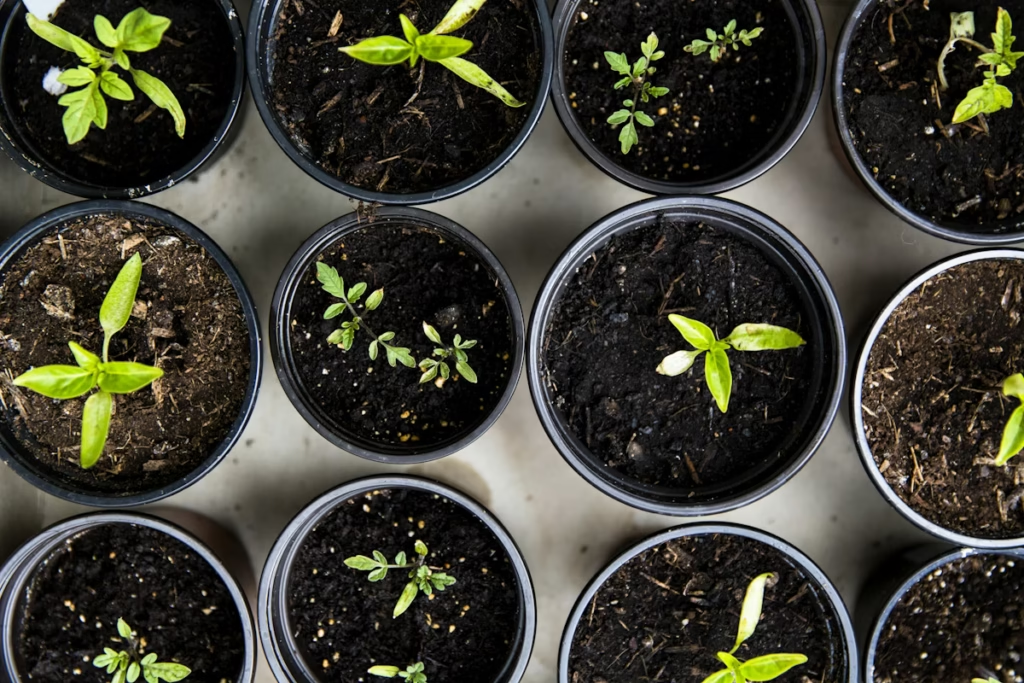
Starting plants from seed is one of the most economical and satisfying aspects of container gardening. A single packet of seeds costs a fraction of what you’d pay for nursery transplants — and gives you access to a far wider range of varieties than your local garden center ever stocks.
For beginners, seed starting can seem complicated, but it’s actually straightforward once you understand the basic requirements. Here is a complete guide to starting seeds for container gardens — from choosing the right supplies to transplanting healthy seedlings into their final containers.
Table of Contents
- Why Start Seeds Instead of Buying Transplants?
- Seed Starting Supplies You Need
- Best Seed Starting Medium
- Seeds to Sow Directly vs Seeds to Start Indoors
- Seed Starting Timing Guide
- How to Plant Seeds Step by Step
- Light Requirements for Seedlings
- How to Water Seedlings
- Thinning Seedlings
- How to Transplant Seedlings into Containers
1. Why Start Seeds Instead of Buying Transplants?
| Advantage | Detail |
|---|---|
| Cost savings | Seeds cost a fraction of transplants — one packet can grow dozens of plants |
| Variety selection | Access to hundreds of varieties not available as transplants at garden centers |
| Earlier start | Start indoors 4–8 weeks before last frost — get a head start on the season |
| Satisfaction | Growing plants from seed is one of gardening’s most rewarding experiences |
| Healthier plants | Home-started seedlings adapted to your specific conditions from the start |
2. Seed Starting Supplies You Need
- Seed trays or small pots — Cell trays (72-cell or 128-cell) are ideal for most seeds. Small pots work well for larger seeds like squash or cucumbers.
- Seed starting mix — A fine-textured, sterile medium specifically designed for seed starting. Never use regular potting mix for seed starting — it’s too coarse.
- Seeds — From reputable seed companies. Check the seed packet for sowing dates and depth.
- Spray bottle — For gentle misting without disturbing tiny seeds.
- Humidity dome or plastic wrap — Creates a warm, humid environment for germination.
- Heat mat (optional but helpful) — Maintains consistent soil temperature for faster germination.
- Grow light — Essential for indoor seed starting unless you have a very bright south-facing window.
- Labels — Essential for keeping track of what you’ve sown. Popsicle sticks work perfectly.
3. Best Seed Starting Medium
Seed starting mix is different from regular potting mix — it’s finer-textured, lighter, and sterile, which encourages germination and prevents damping off disease.
| Medium | Best For | Notes |
|---|---|---|
| Commercial seed starting mix | All seeds — easiest for beginners | Pre-made, sterile, correct texture — most reliable option |
| DIY mix (coco coir + perlite) | All seeds — more economical | Mix 70% coco coir + 30% perlite for excellent results |
| Pure vermiculite | Very fine seeds (begonia, petunia) | Sterile, fine-textured — excellent for tiny seeds |
What to avoid: Never use garden soil or regular potting mix for seed starting. Garden soil contains pathogens that cause damping off, and regular potting mix is too coarse for tiny seedling roots.
4. Seeds to Sow Directly vs Seeds to Start Indoors
| Sow Directly in Final Container | Start Indoors and Transplant |
|---|---|
| Carrots, radishes, beets, turnips | Tomatoes, peppers, eggplant |
| Beans, peas, corn | Broccoli, cauliflower, cabbage |
| Cucumbers, squash, zucchini | Basil, parsley, celery |
| Dill, cilantro, arugula | Petunias, marigolds, zinnias |
| Lettuce, spinach, kale | Lavender, rosemary, thyme |
General rule: Vegetables with taproots (carrots, dill, cilantro) should always be sown directly — they dislike root disturbance. Fast-growing vegetables (beans, peas, cucumbers) are also usually better sown directly. Slow-growing plants that need a long season (tomatoes, peppers) should be started indoors.
5. Seed Starting Timing Guide
| Plant | Start Indoors Before Last Frost | Notes |
|---|---|---|
| Tomatoes | 6–8 weeks | One of the earliest to start |
| Peppers and eggplant | 8–10 weeks | Slowest growers — start earliest |
| Broccoli and cabbage | 4–6 weeks | Cool-season crops — can go out earlier |
| Marigolds and zinnias | 4–6 weeks | Fast-growing flowers |
| Basil | 4–6 weeks | Needs warmth to germinate — don’t start too early |
| Petunias | 10–12 weeks | Slowest flower to grow from seed |
6. How to Plant Seeds Step by Step
- Fill seed trays with pre-moistened seed starting mix — fill to within ½ inch of the top
- Make planting holes — Use a pencil or your finger to make holes at the correct depth (check seed packet — usually 2–3 times the seed’s diameter)
- Sow seeds — Place 1–2 seeds per cell. Larger seeds like tomatoes need only one per cell.
- Cover with mix — Gently cover seeds with seed starting mix and press lightly
- Label immediately — Label with variety name and sow date before you forget
- Water gently — Mist with a spray bottle to avoid washing seeds out of position
- Cover with dome — Place a humidity dome or plastic wrap over the tray
- Place in warm location — Most seeds germinate best at 65–75°F (18–24°C). A heat mat helps maintain consistent temperature.
7. Light Requirements for Seedlings
Light is the most critical factor for healthy seedling growth. Insufficient light causes leggy, weak seedlings that struggle to thrive after transplanting.
| Light Source | Hours Needed | Notes |
|---|---|---|
| LED grow light | 14–16 hours per day | Best option — consistent, controllable, energy-efficient |
| South-facing window | All available daylight | Acceptable but may produce slightly leggy seedlings in early spring |
| Fluorescent shop light | 14–16 hours per day | Good budget option — keep 2–3 inches above seedlings |
Key tip: Keep grow lights 2–4 inches above seedlings and raise them as seedlings grow. Lights that are too far away produce leggy seedlings reaching for the light.
8. How to Water Seedlings
Watering seedlings correctly is critical — too much water causes damping off (a fungal disease that collapses seedlings at the soil line), while too little causes drying out and death.
- Germination phase — Mist the surface gently once or twice a day to keep soil moist. Never let it dry out during germination.
- After germination — Switch to bottom watering. Place the tray in a shallow dish of water and allow the mix to absorb from below for 20–30 minutes, then drain.
- Bottom watering benefits — Keeps the surface dry, which prevents damping off. Encourages roots to grow downward toward the water source.
- Frequency — Water when the top of the mix feels dry to the touch — usually every 1–3 days depending on conditions.
9. Thinning Seedlings
If multiple seeds germinate in the same cell, they need to be thinned to one seedling per cell. Crowded seedlings compete for light, water, and nutrients — and all of them will be weaker as a result.
- Thin when seedlings are 1–2 inches tall
- Use scissors to snip extra seedlings at soil level — never pull them out, as this disturbs the roots of the seedling you’re keeping
- Keep the strongest, most vigorous seedling in each cell
- Thinning is one of the most important steps beginners skip — don’t skip it!
10. How to Transplant Seedlings into Containers
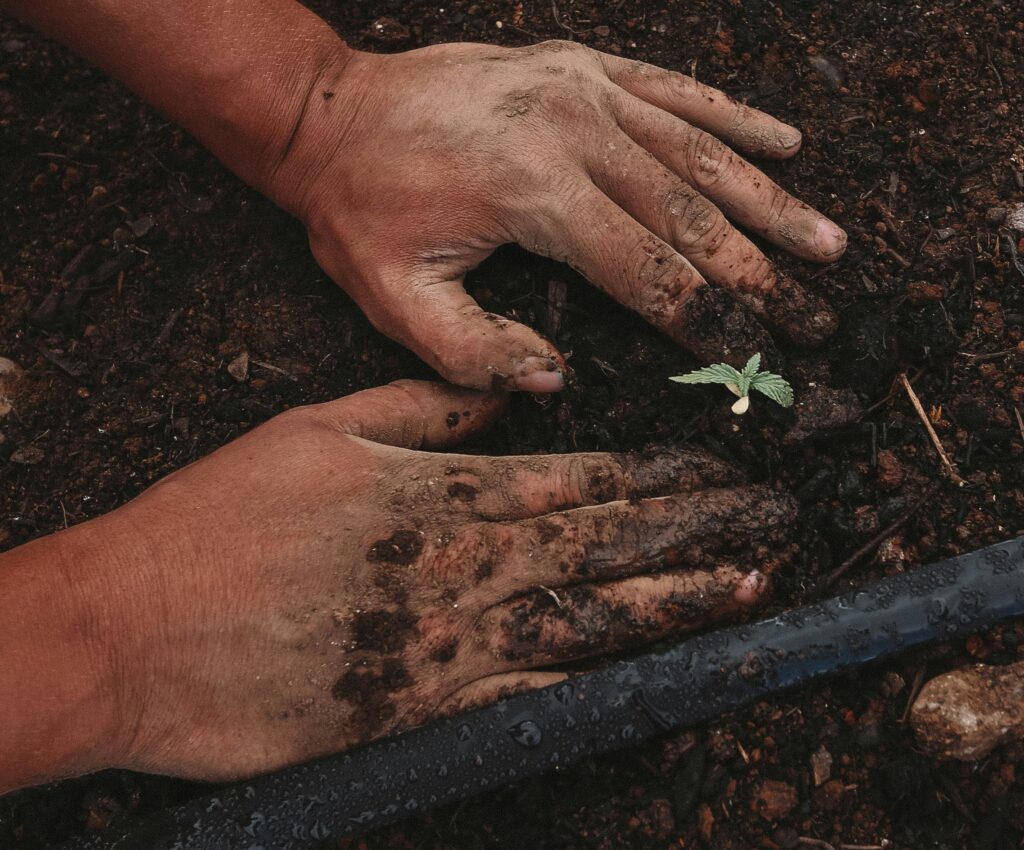
Transplanting is the final step — moving seedlings from their starting trays into their final containers. Do it correctly and your seedlings will barely notice the move.
Step 1: Harden off first
Before moving seedlings outdoors, harden them off over 7–10 days. Start with 1 hour of outdoor time in a sheltered spot, increasing gradually until they can spend a full day outside.
Step 2: Prepare the final container
Fill with fresh potting mix, leaving room for the seedling’s root ball.
Step 3: Water the seedling tray before transplanting
Moist soil holds together better around roots during transplanting.
Step 4: Remove seedlings carefully
Push up from the drainage holes or gently squeeze the cell to loosen the root ball. Handle seedlings by their leaves, never by their stems — a broken stem is fatal, a damaged leaf is not.
Step 5: Plant at the correct depth
Most seedlings should be planted at the same depth they were growing. Tomatoes are an exception — plant them deeper to develop roots along the buried stem.
Step 6: Water thoroughly after transplanting
Water well to settle soil around the roots and provide immediate moisture for the transplanted seedling.
Final Thoughts
Starting seeds for your container garden is one of the most rewarding and cost-effective things you can do as a container gardener. Once you get the basics right — good seed starting mix, adequate light, careful watering, and proper hardening off — you’ll wonder why you ever paid nursery prices for transplants.
Start small, learn from each batch, and build your seed starting skills season by season. The variety of plants you can grow from seed will transform your container garden in ways that buying transplants never could. 🌱
Have questions about starting seeds for container gardens? Visit the Contact page — I’d love to hear from you!
— mumu, Green Garden Tips